
Commercial Vacuum Solutions for Secure Environments
13th Nov 2026
Secure facilities face cleaning challenges that extend far beyond ordinary appearance and routine maintenance. Staff members often work around restricted rooms, controlled access points, sensitive equipment, valuable materials, or environments with strict operational procedures. Cleaning teams need equipment that supports efficient work without creating unnecessary movement, interruptions, or contamination concerns. Commercial vacuum solutions give facility managers the power, capacity, and flexibility to maintain demanding spaces while respecting established security protocols.
The right vacuum also helps teams complete more work within tightly managed cleaning windows. Commercial models offer stronger motors, larger capacities, durable components, and specialized configurations that support repeated use throughout the day. Facilities can match equipment to carpet, hard flooring, debris types, room layouts, and filtration requirements instead of forcing one machine into every application. Cleaning Stuff shares more about our commercial vacuum solutions for secure environments and beyond.
Match the Vacuum to the Flooring
Flooring can change considerably within a secure commercial property, even between adjacent rooms. Carpeted offices may require strong agitation and consistent suction, while hard-floor corridors need equipment that collects debris without scattering it across the surface. Utility areas may present heavier debris or occasional liquid cleanup that ordinary office vacuums cannot manage effectively. Matching the vacuum style to these conditions improves results and helps employees work more efficiently.
Cleaning Stuff offers commercial options for carpet, hard flooring, and demanding cleanup applications. Facility managers can consider backpack, upright, canister, or wet/dry configurations according to the surfaces and spaces their teams regularly encounter. Choosing the right format reduces unnecessary passes and gives workers equipment that fits the physical demands of each assignment. This approach can also help facilities avoid relying on consumer-grade machines that struggle under sustained commercial workloads.
Consider Filtration Requirements Carefully
Filtration deserves close attention anywhere facility managers want to control fine particles during routine cleaning. Vacuuming removes visible soil, but the machine also needs to manage the smaller material that enters its airflow system during operation. HEPA-equipped commercial models can provide an appropriate option for facilities that place greater emphasis on particle capture. Managers should evaluate filtration alongside suction, capacity, maintenance needs, and the specific conditions inside each controlled area.
Teams also need to maintain filters correctly if they expect consistent performance. An overloaded collection bag or neglected filter can restrict airflow and reduce the machine’s ability to collect debris efficiently. Clear maintenance schedules help employees inspect components before equipment enters areas where interruptions create operational problems. Consistent care also supports equipment longevity and gives cleaning managers greater confidence in machine readiness.
Choose a Vacuum Style for the Environment
No single vacuum configuration provides the best solution for every secure building. Layout, flooring, storage restrictions, cleaning frequency, debris, and access procedures all influence which machine makes the most practical choice. A compact unit may work well in tight offices, while a larger machine may better serve expansive corridors or demanding maintenance areas. Managers should compare how each design supports the actual movements and responsibilities of the cleaning crew.
Common commercial configurations include:
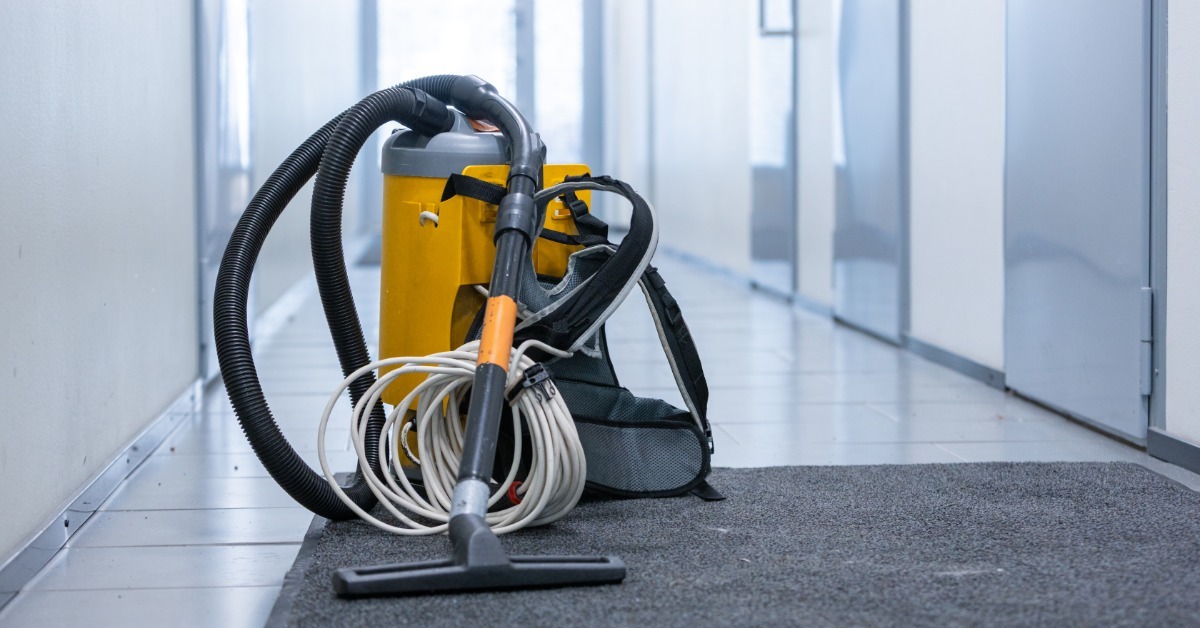
- Backpack vacuums for mobility through offices, stairways, and areas with furniture or other obstacles.
- Upright vacuums for efficient cleaning across larger carpeted spaces and regularly maintained office areas.
- Canister vacuums for flexible cleaning around corners, furnishings, hard floors, and mixed surfaces.
- Wet/dry vacuums for maintenance areas and cleanup situations that may involve liquids or heavier debris.
Support Controlled Cleaning Workflows
Security procedures often determine when crews can clean and how they move through a building. Some facilities provide limited access windows, require escorts, restrict equipment movement, or maintain detailed records for items that enter sensitive areas. Cleaning equipment should support those procedures instead of adding avoidable complexity to them. A practical vacuum setup can help crews finish assigned zones efficiently before access conditions change.
Portability plays an especially important role in environments with multiple checkpoints or physically separated work areas. Long power cords can extend working range where facility rules permit them, while backpack and compact canister designs can make movement through confined spaces easier. Larger-capacity machines may reduce stops for bag changes or debris disposal during lengthy assignments. Facility managers should balance these conveniences against storage, electrical, noise, and security requirements before selecting equipment.
Account for Heavy Commercial Use
Commercial cleaning equipment often runs much longer and more frequently than a vacuum designed for occasional household use. Motors, hoses, wheels, cords, switches, filtration components, and collection systems all face repeated wear when crews clean large facilities every day. Choosing heavy-duty vacuum cleaners designed for professional workloads can help managers reduce problems associated with equipment that cannot withstand demanding schedules. Quality commercial equipment also gives cleaning teams a more dependable foundation for consistent daily work.
Equipment capacity deserves similar consideration because frequent emptying can slow down large assignments. A vacuum that suits a small administrative office may become inefficient when employees use it across extensive carpeted areas or high-traffic corridors. Managers should consider square footage, soil levels, cleaning frequency, and expected runtime when comparing machine sizes. Selecting enough capacity for normal workloads can keep employees productive without forcing them to operate unnecessarily bulky equipment.
Reduce Cross-Area Equipment Movement
Secure environments often benefit from limiting how frequently tools travel between separate zones. A facility may choose to dedicate particular machines to departments, floors, controlled rooms, or areas with distinct cleaning requirements. This strategy can simplify equipment management while reducing unnecessary transportation through checkpoints. Dedicated equipment can also help supervisors establish predictable cleaning routines for each assigned area.
Color coding, equipment labels, storage assignments, or inventory records can make this approach easier to manage. Supervisors can identify which vacuum belongs in a specific area and quickly notice when equipment appears outside its normal location. Teams can also establish separate maintenance schedules according to the workload each machine receives. These simple organizational practices can complement broader security procedures without making routine cleaning unnecessarily complicated.
Build a More Reliable Cleaning Program
Cleaning Stuff gives businesses access to backpack, upright, canister, wet/dry, industrial, and HEPA vacuum options for a wide range of professional applications. Facility managers can compare configurations according to their flooring, cleaning intensity, and operational demands instead of settling for equipment intended for lighter household use.
The right commercial vacuum in a secure environment can improve productivity, simplify recurring maintenance, and provide dependable performance across challenging spaces. Investing in equipment that matches the environment gives cleaning professionals the tools they need to maintain secure facilities with greater consistency and control.